⚙️
Motors
Pumps, blowers, feature pumps, and some equipment can require careful attention because motors are different from simple lighting loads.
Behind the blue water is a serious electrical system: pumps, filters, timers, automation panels, salt systems, lights, heater controls, spa equipment, waterfalls, fountains, valves, sensors, and enough wiring to make the pool guy suddenly remember lunch.
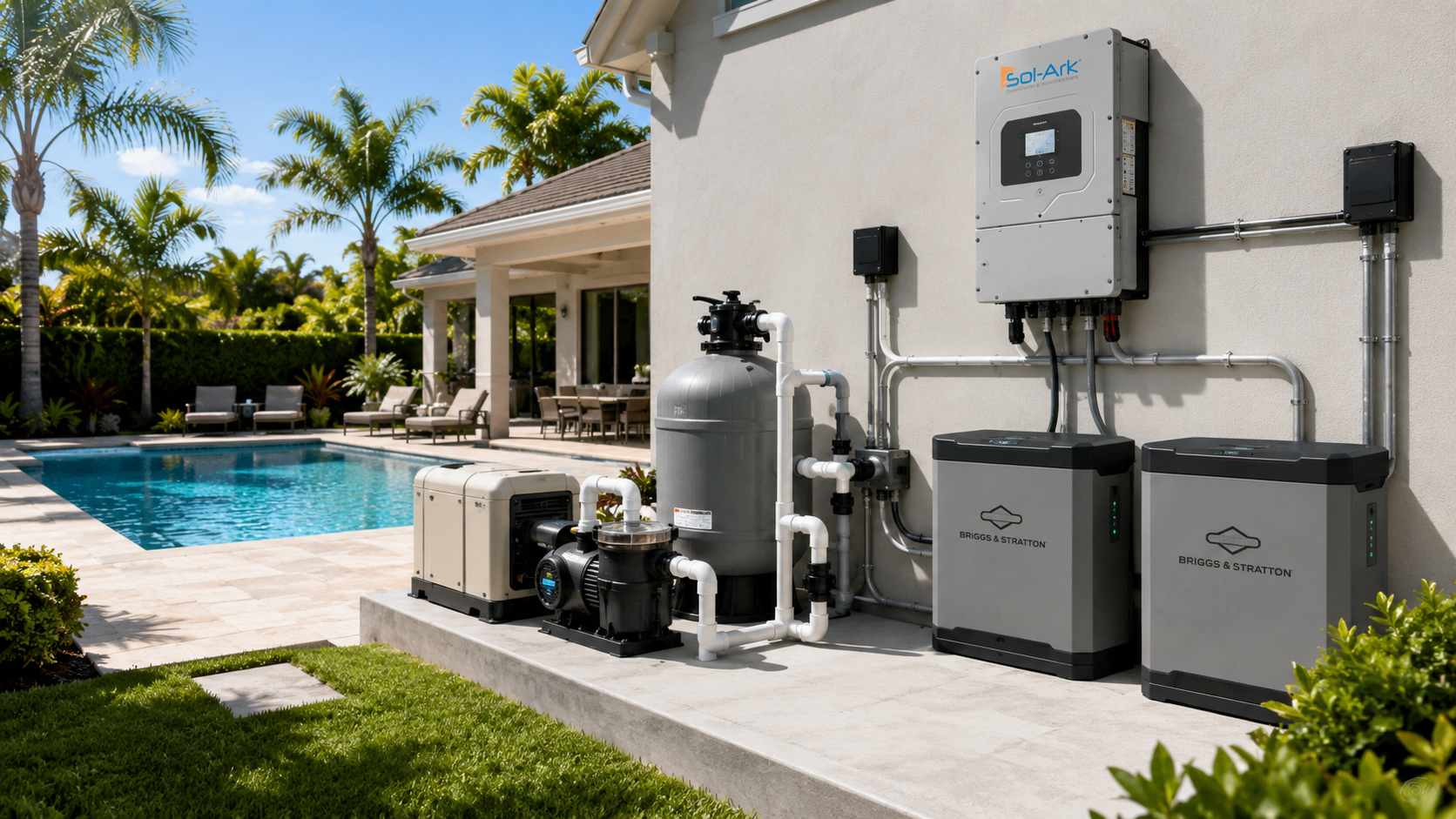
The equipment pad is the command center. It may not have the glamour of the pool tile, the spa, or the waterfall, but it is where the motors, controls, and schedules live.
Solar Pool Man starts here because this is where the real load conversation begins: what runs, what it draws, how often it runs, and what must keep working when the grid fails.
It does not make power. It eats power. Some loads sip. Some gulp. Some start hard, run long, and then act surprised when the bill shows up wearing goggles.
Pumps, blowers, feature pumps, and some equipment can require careful attention because motors are different from simple lighting loads.
Automation panels, timers, sensors, relays, and salt systems may not be the biggest loads, but they coordinate the backyard.
Pool lights, patio lights, and landscape lighting can be part of the comfort and safety story, especially after sunset.
Some pools are simple. Some are backyard resorts with pumps breeding behind the hedge. The design starts by naming everything.
Main pool pumps, variable-speed pumps, filtration loops, and daily runtime schedules.
Spa jets, blowers, controls, valves, lighting, and the circuits that make hot water feel like a vacation.
Salt chlorination and control equipment that depend on circulation and proper scheduling.
Fountains, waterfalls, sheer descents, decorative pumps, and the lovely sound of electricity moving water.
Pool and spa heater support circuits, controls, and coordination with pump operation.
Remote apps, schedules, relays, valves, timers, and control panels that decide what runs when.
Pool lights, landscape lights, patio circuits, and security lighting around the backyard.
Selected equipment that may deserve backup support depending on goals, circuits, and capacity.
“The pool equipment pad is where beautiful water meets ugly amperage.”
— Solar Pool Man, pointing at a breaker with pool-service confidenceBattery backup should be selective. During an outage, the goal may be basic circulation, equipment control, safety lighting, or limited operation. It usually is not necessary to make every waterfall, spa jet, and party light behave like nothing happened.
The design question is simple: which pool loads actually matter when power is limited?

Homeowners often think of the pool as one thing. Solar Pool Man sees a lineup of suspects: the pump, the spa, the salt system, the automation, the lights, the waterfall, the heater controls, and the mysterious breaker labeled “POOL???”
“When the breaker says ‘pool,’ that is not a design document.”
— Solar Pool Man, refusing to guess professionallyThe right plan comes from real equipment facts, not backyard optimism.
| Equipment | What To Check | Why It Matters |
|---|---|---|
| Main pool pump | Horsepower, voltage, pump type, runtime, schedule | Usually the first and most important pool load to evaluate. |
| Variable-speed pump | Speed settings, daily schedule, control integration | Can reduce energy use, but still needs smart scheduling. |
| Pool automation | Controller, relays, valves, timers, app control | Coordinates other loads and may be important during limited operation. |
| Salt system | Electrical draw, interlock with pump, operating schedule | Depends on circulation and should be coordinated with pump operation. |
| Spa equipment | Jets, blower, controls, heater interaction | Can create large loads and may not be a blackout priority. |
| Water features | Feature pump size, runtime, control switch | Often beautiful, often optional during backup operation. |
| Lighting | Pool lights, landscape lights, safety lighting | May be useful as a lower-load nighttime comfort and safety feature. |
| Heater controls | Control circuits, pump dependency, fuel or electric connection | Heating systems can require careful review before backup assumptions. |
Pumps, lights, salt systems, heaters, automation, and water features each deserve their own look.

Heating is comfort. Heating is also a serious design conversation. Controls, pumps, fuel, electric load, and runtime all matter.
Review Heaters
Salt systems rely on circulation and scheduling. They belong in the solar equipment review.
Open Salt Systems
Automation decides what runs. Solar Pool Man wants it working with the solar plan, not against it.
Open AutomationA battery without a load list is just an expensive box hoping the backyard behaves. Name the equipment, understand the circuits, and design around real priorities.
Pool equipment should be reviewed by qualified pool and electrical professionals. Solar and battery design must account for pump size, voltage, breaker layout, startup behavior, runtime, code requirements, utility rules, and practical homeowner priorities.